


Finding the right candidate is only half the job. The 4 F's show you what makes someone respond, stay engaged and ultimately say yes, so you can shape the process around what actually matters to them.
Part 1 covered how to understand the business behind every brief. Once you know who you're looking for, the next problem starts: getting that person to reply, stay interested, and accept the offer.
Two recruiters can make exactly the same placement in completely different ways.
Recruiter one reaches out to hundreds of people, interviews dozens, submits ten or twelve candidates and eventually makes the hire.
Recruiter two reaches out to 30 or 40 people, interviews five, submits three and makes the same placement.
The second recruiter gets more from the right people once they have been found. That means fewer profiles to source, fewer interviews to run and fewer candidates to submit for the same outcome.
The difference sits in conversion. Why does the candidate respond? Why do they stay interested? Why do they accept the offer?
Finding the Right Person Is Only Half the Job
A great shortlist has very little value if the candidates never reply, drop out halfway through the process, or reject the offer at the end. And when conversion is weak, it can be tempting to throw more people into the funnel.
Let's be clear about that. You cannot solve a conversion problem with more candidates. That will only leave you disappointed more often.
Candidates aren't leads, and they aren't numbers in your pipeline. They're people making one of the bigger decisions of their year, usually with a partner, a mortgage and a career plan attached to it.
Salary matters, but it's one input among several. Their goals, their values, their family, their finances and the people they'd spend their days with all shape the answer.
The better you understand those forces, the less you have to lean on volume or money to close the hire. That is what the 4 F's help you do.
The Four Forces Behind Every Decision
The framework here is adapted from Who: The A Method for Hiring by Geoff Smart and Randy Street. The 4 F's give you a simple way to understand the main forces shaping a candidate's decision, from the first approach through to the final offer.
- Fit: Does this opportunity move the candidate toward the career and life they actually want?
- Family and Friends: What do the people around them need to feel comfortable with the move?
- Fortune: Does the financial equation make sense?
- Fun: Can they picture enjoying the people, culture and day-to-day reality of working there?
Not every F carries the same weight for every person, and that's the point. Your job is to work out which ones matter most to this individual, then shape the process around them.
Fit
Imagine another recruitment agency trying to headhunt you. They tell you the role involves taking briefs, sourcing candidates, interviewing people and speaking with hiring managers.
Excited? Of course not. That is already your job.
Yet this is how most roles get pitched. Service-provider recruiters tell candidates what their daily tasks will be, even though they already know what somebody with their job title does all day. You are not going to make someone change jobs by describing their current job back to them.
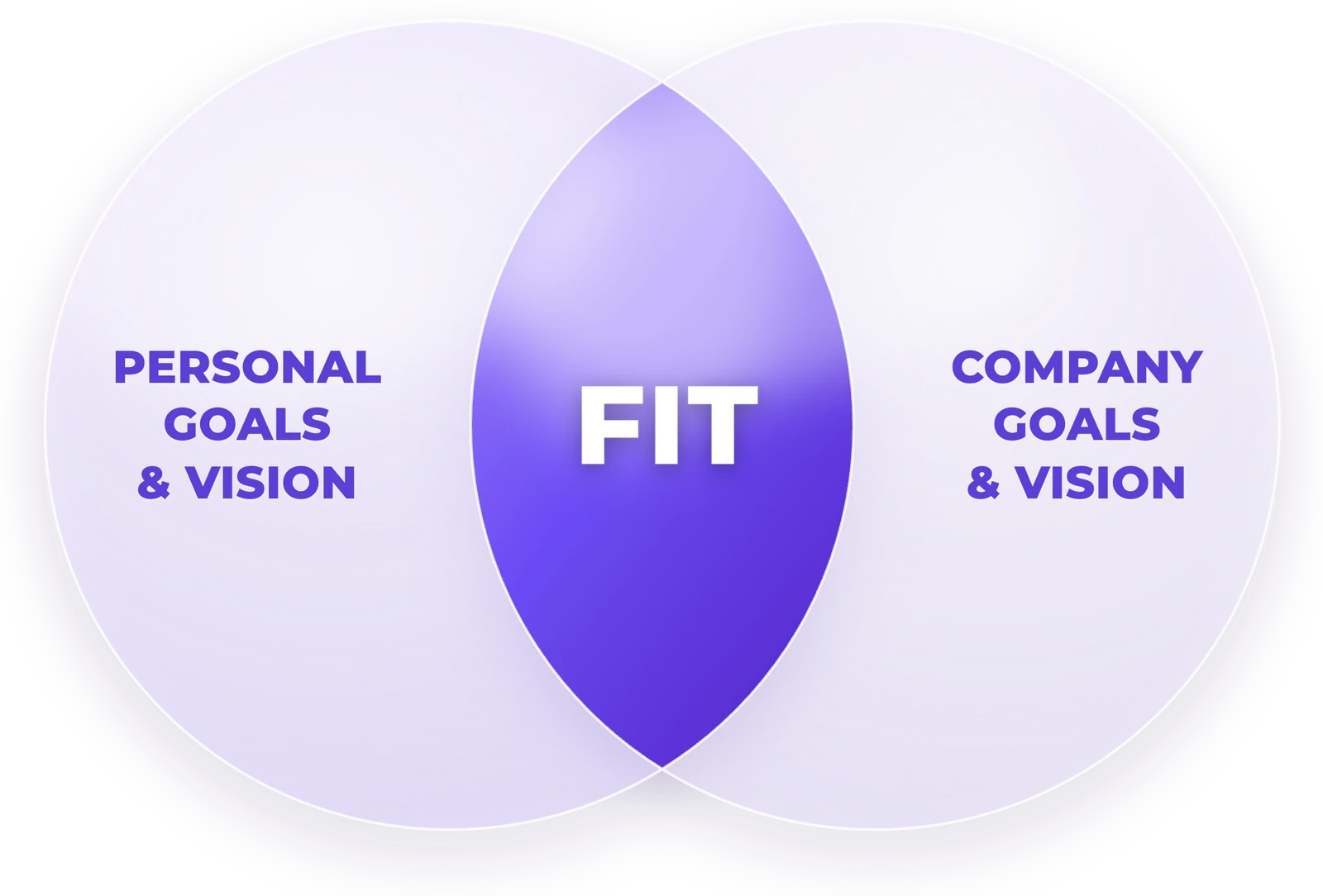
Fit starts somewhere else. You need to understand where the candidate wants to go and whether the opportunity can help them get there.
Maybe they want to build something from an early stage. Maybe they want international exposure, their first leadership role, a bigger challenge or more control over their time.
Values work the same way. If your candidate values work-life balance, they will assess a high-intensity culture very differently from someone actively looking for that kind of environment.
Find that direction first, then pitch the overlap between what they want and where the company is going. Their goal is the mission. The company is the vehicle. Your pitch is the moment those two line up.
Useful questions include:
- What do you want your next move to give you?
- What are you missing in your current role?
- What would make an opportunity genuinely exciting?
- Where do you want your career to go next?
- What kind of environment brings out your best work?
The stronger that overlap, and the more honest you are about where it doesn't exist, the stronger your Fit. Being straight with someone about what a role won't give them costs you one candidate and earns you a relationship.
Family and Friends
You may have spoken to a candidate who was completely sold on a role on Tuesday afternoon and came back on Wednesday morning saying they need to think about it.
Nothing happened at the company overnight. They went home and spoke to someone whose opinion outweighs anything a recruiter says.
Career moves rarely happen in isolation. Partners, family and close friends can shape how attractive or risky a move feels, especially when relocation, travel, working hours or financial commitments are involved.
Which makes one of the most valuable pre-close questions also one of the simplest: "Is there anyone else you'll want to talk this through with before you decide?"
That question reveals who else has a seat at the decision table, and it helps you know which concerns may need attention before the offer arrives.
When a concern traces back to relocation, travel or working patterns:
- Ask what specifically worries them
- Give them real numbers and examples
- Connect them with someone at the company in a similar situation
- Give them something concrete to take back to the conversation at home
Don't argue against the objection. Candidates rarely get talked out of a role by a flat no. They get talked out of it by uncertainty. Your job is to remove the uncertainty, and to be fine with the outcome if the move genuinely isn't right for their household.
Fortune
We all like to say money isn't everything. In the BlackBerry movie, there's a scene where the company pays a key hire a huge signing bonus just to get him through the door. Money moves people, and pretending otherwise doesn't help anyone.
That means understanding whether the package is viable for the candidate, and whether it is attractive enough to justify the change.
The stronger the candidate feels about Fit, Fun and Family, the less compensation has to carry the decision on its own. If those factors are weak, money has to do more of the convincing.
Get ahead of it by:
- Understanding expectations early
- Knowing what the candidate needs for the move to make sense
- Checking whether the client can realistically meet it
- Surfacing gaps before the offer is written
The offer should never be the moment anyone finds out the numbers don't work. That's a bad day for you, a worse one for the candidate, and entirely avoidable.
Fun
People do not only choose jobs because of the work they will take on. They choose them because of the people they will spend their days with.
That makes Fun significantly harder to sell. You can explain a mission and show the salary. But telling someone your client has "great office vibes" proves absolutely nothing.
You'd never convince someone a party is good by reading out the guest list. You have to get them into the room.
As a recruiter, your job is to create moments where candidates can experience the "party" for themselves and see how their potential coworkers interact in an informal setting. You cannot manufacture Fun, but you can make sure it becomes visible.
- Introduce them to future teammates
- Bring them into the office
- Set up an informal coffee or lunch
- Arrange a casual call with someone they would work with
- Let them picture themselves there
If an office visit makes little sense, another human touchpoint can achieve the same purpose. A hiring manager can record a short personal video. A future colleague can join a casual call. A team member can answer the questions that never make it into a formal interview.
Use the Four F's Throughout the Process
Do not wait until the offer stage to start thinking about Fit, Family, Fortune and Fun.
You sit between the candidate and the hiring manager, which makes you the only person in the process who knows what this individual needs in order to say yes. Use that. Consult your hiring manager and keep taking the candidate's temperature as things move:
- How do they feel about the company now?
- Are they bought into the mission?
- How did they feel about the team?
- Has anything changed since the last conversation?
- Is there anything making them hesitate?
The answers tell you what should happen next. If Fit is weak, help the hiring manager make the mission and impact of the role crystal clear. If Family or lifestyle concerns appear, surface it early and go find the information that settles it. If Fun is missing, create another human touchpoint with the team. If the numbers are drifting apart, deal with it before the final offer is written.
That's what it means to shape a process instead of waiting for objections to show up at the end.
By the time the offer lands, you should already know how this person feels about the company, the mission, the team and the package. The offer should confirm a decision that has been building for weeks, not start one.
Key Takeaways
- Treat conversion as seriously as sourcing. Finding exceptional talent only creates value if you can turn them into a candidate and then a hire.
- Understand what the candidate wants. Fit, Family and Friends, Fortune and Fun carry different weight for everyone, which means you can't pitch two candidates the same way.
- Shape the process around what is missing. If the candidate needs more conviction around the mission, people or package, create the right next step to address the concern.
- Never assume yesterday's enthusiasm survived the week. Know what's strengthening the decision and what's weakening it.
Understand the decision well enough, and by the time the offer arrives there's very little left to decide.