


Great recruiters do more than fill vacancies. They understand the business problem behind the brief well enough to challenge assumptions, define what success actually looks like and find candidates with the track record to solve it.
No hiring manager has ever woken up wanting five CVs in their inbox.
They wake up with a revenue target, a product that has to ship, a market to enter, or a team that keeps missing its numbers. The vacancy is only what that problem looks like by the time it reaches you.
If all you offer is a CV, it becomes very easy for a client to compare you with every other recruiter sending over a stack of CVs. And once the service looks interchangeable, price becomes one of the few things left to negotiate.
The easy money is gone, and everyone can feel it
When work gets harder to win, the instinct is to make it cheaper. It's a completely understandable instinct. When your pipeline is thin and rent is due, cutting your fee to get the job feels like the responsible thing to do.
But that's a race to the bottom with no prize at the finish line.
The recruitment businesses that continue to command premium fees give clients something that is harder to compare. They understand the company, challenge the brief, know the market and help the hiring manager make a better hiring decision.
They become the Bentleys and Ferraris of recruitment.
Your client has a business problem, not a vacancy
Your job isn't to push CVs to your hiring manager or close a vacancy. That would be too easy.
Your job is to understand the business problem well enough to find the one person who can solve it.
As a quote often attributed to Einstein puts it:
"If I had one hour to solve a problem, I'd think 55 minutes about the problem and five about the solution."
Most recruiters do the opposite. They open the intake by asking for the persona and the requirements, then spend the rest of the hour thinking about sourcing angles.
It's what the industry trained into a whole generation of recruiters, and it's exactly why so many of us get treated as a service provider.
Start with the business instead, and the conversation changes. You stop being the recruiter waiting for a brief and become someone with a point of view about the problem. Hiring managers notice immediately, because almost nobody else is doing it.
And solving that business problem means understanding four layers that sit behind every hire.
Four things to understand before you source
Acting like a business partner requires more than asking a few smarter questions in the kickoff. You need to understand the business deeply enough to form a point of view before the search even starts.
There are four key areas you as a recruiter must understand. Together, they give you the context behind the vacancy:
- The company tells you where the business is going.
- The department tells you what needs to change to get there.
- The role tells you what this person needs to accomplish.
- The industry gives you the knowledge to judge what relevant experience actually looks like.
Whether you run a boutique recruitment agency or recruit yourself, you should know the market well enough to have a point of view, not be someone who takes an order.
1. Understand the company
Every vacancy started as a business plan. To understand what makes the right talent, you have to understand the company, its vision, mission and goals just as well as the hiring manager (if not better!).
You have to understand exactly how they make money, whom they serve, what exact problem they solve, and what's on their roadmap for this year, regardless of the role you hire for.
Questions worth answering include:
- What's their overall vision and mission?
- What industry are they in?
- What's the business model?
- Who's the ideal customer?
- What problem do they actually solve?
- How do they price?
- How do they actually make money, and what other revenue streams exist?
- Who are their biggest competitors?
- What's on their roadmap?
- How much revenue do they make?
- What are their goals for the company?
Nobody's asking you to turn a kickoff into a consulting project. You just need to know enough to understand why this vacancy exists and what kind of experience will actually matter once someone steps into it.
2. Understand the department
Once you have a clear picture of the company, it's time to go one level deeper into the department.
It is not enough to understand the projects the team is working on or what the new hire will do day to day. You want to know how the department is structured, who sits around the hire, what the team is responsible for, which goals and KPIs matter, where it is struggling and what this person is expected to unlock.
Useful questions to ask include:
- How is the department structured today?
- What is the department trying to achieve this quarter and this year?
- Which KPIs matter most?
- What projects are running right now?
- Where are the biggest bottlenecks?
- What capability is missing from the team today?
- What needs to work differently after this person joins?
- What stands out as unusual about the way this team operates?
This is where you start forming an opinion about the brief.
If the team needs someone to build from zero, a candidate who has only operated inside mature organisations is a weak fit, however perfect the title looks. If marketing needs a performance engine, ten years of brand experience sounds impressive and solves nothing.
The deeper you understand the department, the easier it gets to separate relevant experience from impressive experience. And the easier it gets to explain that difference to a hiring manager who's attached to the wrong profile.
3. Understand the role
Only now should the conversation narrow to the job itself.
By this point, you should already understand the company and the department well enough to know why the hire exists. Now the job is to translate that context into what this person actually needs to accomplish.
Focus on the mission, goals and objectives, daily responsibilities, and the competencies needed to succeed. Only once those things are clear should you start deriving the candidate persona.
Questions worth answering include:
- How does this role contribute to the company's goals?
- How does it contribute to the department's goals?
- What are the most important KPIs?
- What does this person need to achieve in the first 6 months?
- What should they have achieved after 12 months?
- Which problems will they be expected to solve?
- What competencies are required to make those outcomes happen?
That's how a role stops being a job description and becomes a definition of success.
4. Understand the industry
The last layer is everything sitting around the company and the role.
You do not need to be an engineer, marketer, product manager or salesperson. But you need enough understanding of the industry to talk to hiring managers and candidates at eye level and know exactly what the industry standard is.
That is why recruiters who act as business partners get nerdy about the industries and markets they recruit in.
They understand how the companies work. They know which problems practitioners are solving. They understand the terminology well enough to go beyond buzzwords. And over time, they build a view of what separates a strong candidate from someone who simply looks strong on paper.
The fastest way to build that fluency is to get closer to the work.
- Understand the work behind the title. Ask how the product is built, and not just which languages or tools are used. Ask what that actually means. How does the product process data? What's the business goal behind the stack? Where are the trade-offs?
- Go where your candidates go. Meetups, communities and industry events create a faster education than another hour reading job descriptions. Conversations reveal what people care about, what they are building, which companies have strong reputations and what good work looks like inside the profession.
- Get closer to the people doing the work. Sit in on meetings. Speak with department leaders. Listen to the podcasts candidates listen to. Ask how teams are structured, how success is measured and what strong performers do differently.
- Build fluency, not expertise. Enough to hold a credible conversation, recognise strong experience and ask a better question. A recruiter never needs to become the engineer, marketer or product manager. The recruiter needs enough fluency to know what good looks like.
Yes, you have to get a little nerdy about it. That's the part most recruiters skip, and it's the part clients happily pay a premium for.
By now you should be able to explain why the vacancy exists, what the company is trying to achieve, what needs to change inside the department, what success looks like in the role, and the market this person will operate in.
Free template: turn every job brief into a repeatable process
Doing all of this from memory on every new brief is its own kind of exhausting. It shouldn't live in your head.
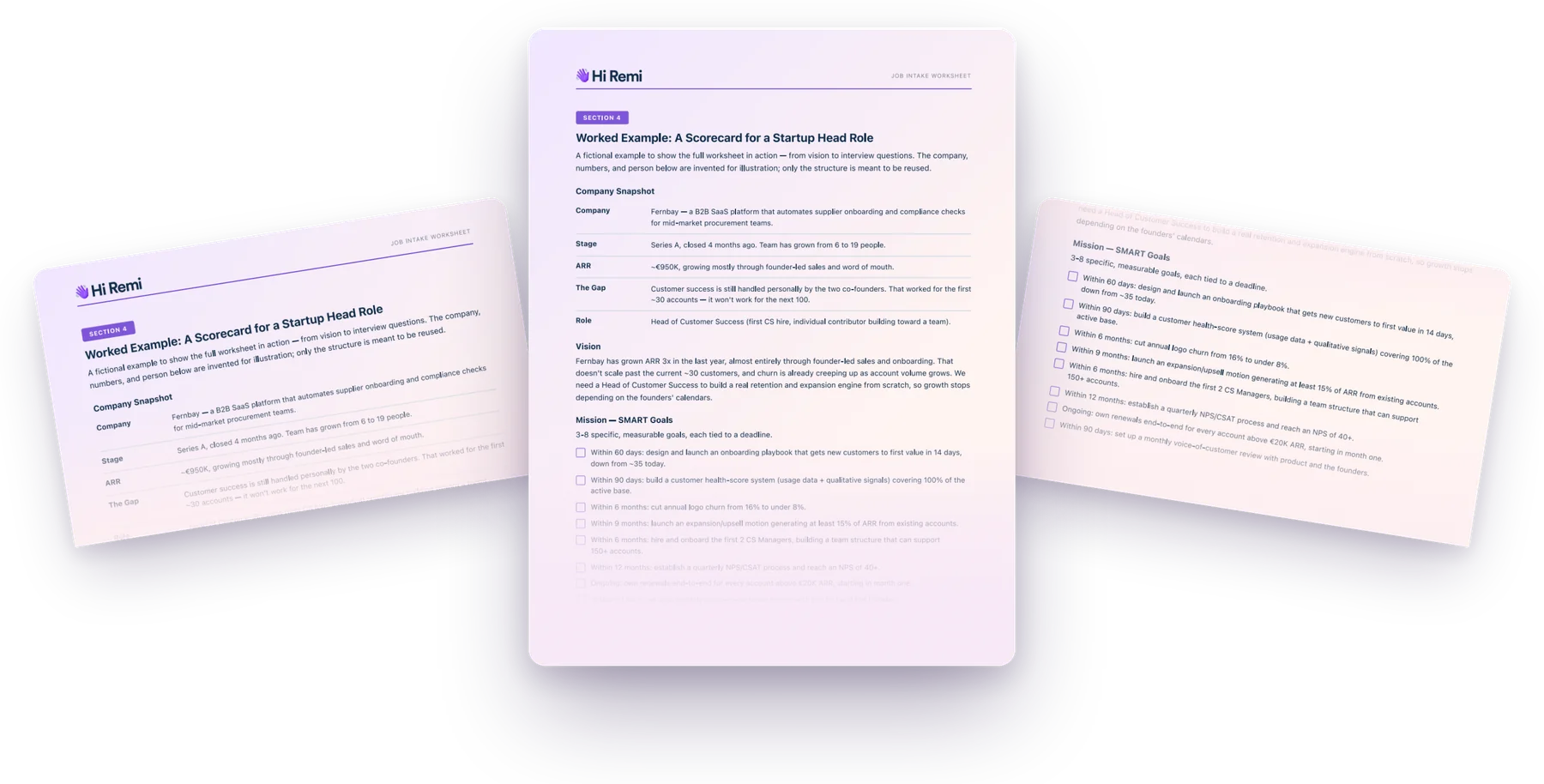
The Job Intake Worksheet turns it into a process you can run every time, including what to research before the kickoff, what to uncover during a structured 60-minute intake, and how to turn that conversation into a scorecard that guides candidate evaluation for the rest of the search.
Key takeaways
By this point, the shift from service provider to business partner should be practical. You are no longer just taking a vacancy and turning it into a search. You are using business context to shape the brief, define what success looks like, and judge candidates against the problem the company actually needs to solve.
That changes how you work:
- Start with the business problem, not the candidate profile. Before titles, years of experience or target companies, you understand what the company is trying to achieve and why the vacancy exists in the first place.
- Connect company, department and role. You know how the hire contributes to the wider business, what needs to change inside the team, and what the person should have achieved after six or twelve months.
- Challenge the brief when it does not make sense. Requirements are not fixed. Use your understanding of the business and the market to question assumptions and help the hiring manager sharpen what they actually need.
- Judge candidates by relevant track record. Look for evidence that someone has solved a similar problem in a comparable environment rather than relying on titles and company names.
- Build enough market fluency to have a point of view. Understand the work behind the titles and the differences between seemingly similar candidates well enough to explain why one is more relevant than another.
Next in the series
Understanding the business tells you who to look for. It doesn't get that person to reply, stay engaged, or sign. Part 2 covers the four forces behind every career decision, and how to work with them from first message to signed offer.

Free download
Job Intake Worksheet
Put this article into practice on your next search. Get the free PDF.
 Download the free PDF